
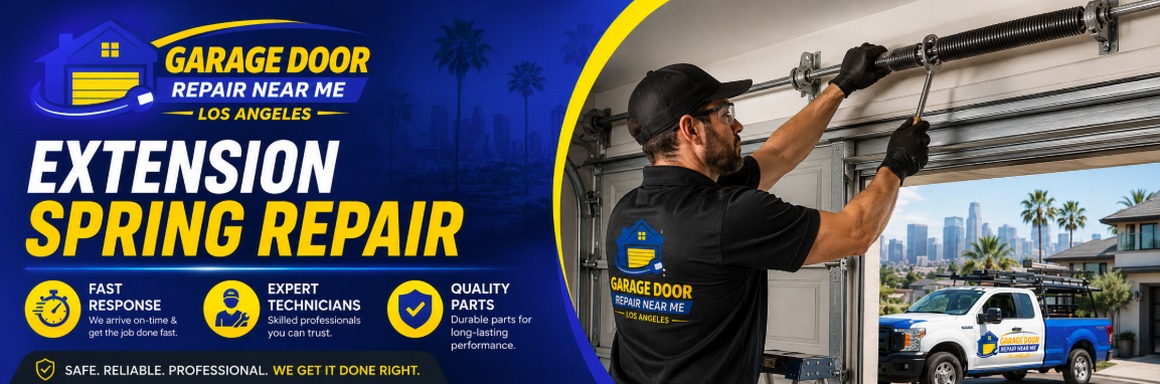
Extension Spring Repair in Los Angeles
One spring hanging visibly longer and slacker than its partner, or lying on the garage floor altogether, is how most people meet this repair. Those long stretched springs run horizontally above the car on either side, parallel to the tracks, and they work by pulling out as the door comes down rather than by winding up. They are the older arrangement and they turn up constantly on the single doors and mid century houses common through Van Nuys, Eagle Rock and the older streets of West Adams.
We repair and replace them across Los Angeles from $129 a pair, and we fit safety containment cables through them as a matter of course.
How to Spot a Failed Extension Spring
Look along both tracks. Two springs of visibly different lengths, one hanging slack while the other is taut, means one has broken or stretched past its useful life. Sometimes a spring is simply lying on the garage floor, which removes any doubt. The door will typically sit crooked in the opening, sag on one side, feel enormously heavy to lift by hand, or refuse to stay up at all. In case you heard a sharp metallic twang rather than the deep bang associated with torsion failures, extension springs are almost certainly what you have.
Safety Cables Are Not Optional
This is the point worth taking away from the page. An extension spring stores its energy in tension along its whole length, and when one snaps without a containment cable threaded through the middle of it, several feet of spring steel travels across the garage at speed. A safety cable runs from the rear track hanger through the spring's core to the front bracket, does nothing at all in normal service, and catches the whole assembly on the day it fails. A great many older Los Angeles doors have none. Where we find one that does not, we fit them, and on any door we replace springs on they are included rather than sold as an extra.
Why These Doors Go Out of Square
An extension system pulls on each side of the door independently, and that is its weakness as well as its simplicity. Two springs of the same age rarely lose their tension at exactly the same rate, so one side begins lifting fractionally ahead of the other, and the door starts arriving at the top very slightly twisted. Left alone it wears the rollers on the lagging side, drags in the track, and eventually jumps out of the rail altogether. It is the single most common reason we attend an extension door for something that has nothing obviously to do with springs, and our off track repair page picks the story up from there.
Always Replaced in Pairs
As with torsion systems, extension springs are matched and age together, so replacing one and leaving its partner produces a door that pulls unevenly and a second failure within months. Uneven pull on this arrangement also drags the door out of square inthe opening, which chews rollers and eventually puts the door off its track. Our off track repair page covers what that looks like when it goes that far.
Pulleys, Cables and Brackets
An extension system involves rather more small hardware than a torsion one, and the pulleys at each end are the parts most often overlooked. Pulley bearings seize, the sheaves wear a groove that saws through the cable, and the S hooks and brackets holding everything to the track hanger fatigue quietly for years. While the springs are off, our technician replaces worn pulleys, inspects the lift cables end to end and checks every bracket, since all of it is exposed at that moment and none of it is expensive compared with coming back.
Living With an Older Extension Door
Plenty of these doors have another decade in them and there is no reason to replace a system that is working. All we would suggest is that you glance at the springs twice a year with the door shut, since a stretched spring shows it, and that anything hanging visibly longer than its partner is mentioned before it fails rather than afterwards. Keep the pulleys and the spring coils lightly oiled and leave the tracks alone. And if the door has no containment cables through the springs, have those fitted at the next opportunity whether or not anything else is wrong.
Should You Convert to Torsion?
On a door that keeps failing, or one that has been made heavier with insulation or a timber facing, converting to a torsion system is worth pricing. Torsion gives better control, longer life, a quieter run and a door that stays square, and it clears the clutter of springs and pulleys away from the ceiling. It does need about twelve inches of headroom above the opening, which some older Los Angeles garages simply do not have. Our technician measures and gives you both figures. Extension repairs start at $129 a pair fitted, conversions are quoted individually, and neither is charged extra at night or on a weekend. The comparison between this arrangement and a torsion system sits on our garage door spring repair page.